
The architecture of airports is now widely considered as more than just serving a function. They play a major part in transforming the passenger experience. And what better way than to reward the World’s Most Beautiful Airports.
The annual accolades, presented by Prix Versailles, highlight the terminals that combine operational, ecological, and aesthetic qualities. The recently released 2026 list includes airports, with four in Asia, two in North America and one in Europe.
These projects, each one exhibiting extraordinary architecture, illustrate how airports are turning away from the old standards to offer the world a richer, more harmonious point of view.
Introducing this year’s selection, Jérôme Gouadain, Secretary General of the Prix Versailles, said: “Whether they have newly appeared on the horizon or undergone a major renovation, contemporary airports and airport terminals are innovative, inescapable hallmarks of their regions and their eras.
“They are innovative, because they resolve the apparent conflict between the increasing frequency of travel and the need for speed, both central to an airport’s purpose on the one hand and, on the other, the singularity of a form of tourism that aims to be accessible and that values people’s time in places that, in this day and age, can no longer be described as mere ‘transfer’ spaces.
“And they are inescapable, in that this infrastructure leaves a lasting environmental footprint on the land but also on the history of humanity: in the amalgamation of architecture that they display, airports are becoming attractive settings, emblems of economic, cultural and social dynamics that will continue to shape the societies of tomorrow, draw them together and unify them.” The chosen few for 2026 are:
Guangzhou Baiyun International Airport Terminal 3
Guangzhou, China
Guangzhou, the “City of Flowers”, is known for its inventive architecture. This can seem paradoxical, when its multi-millennial roots are showcased like they are in this new terminal. Drawing from Lingnan culture, the edifice serves as a gateway dedicated to lifestyle, on a monumental scale.
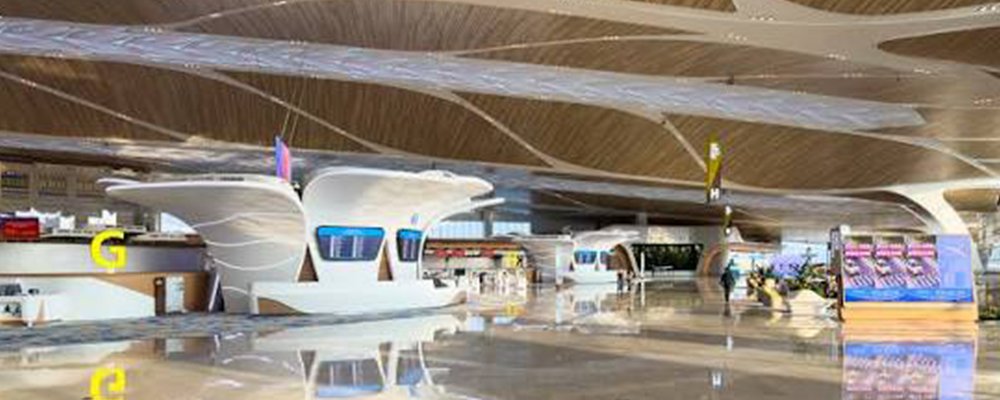
In this sprawling extension, which was entrusted to Artelia in collaboration with the Guangdong Architectural Design and Research Institute (GDAD), nature is what gives structure to the different spaces. The stylised cycle of clouds, water and flowers produces an intuitive, light-filled layout with fluid, organic curves to guide travellers on their way.
The overall effect calls to mind the prosperity of the Maritime Silk Road and brings movement, clarity and exchanges to the forefront in an ever-blossoming décor. Through rhythmic sequences of terraces, atriums and gardens, including the highest openair public observation deck at a Chinese airport, Terminal 3 has emerged as an icon of hospitality, one that is avant-garde and yet imbued with age-old history, just like the Greater Bay.
Lokapriya Gopinath Bardoloi International Airport Terminal 2
Guwahati, India
There are few airports that embrace a land so magnificently. In Guwahati, the international Terminal 2 delivers a spectacular arrival experience that reflects the living spirit of Northeast India. At the crossroads of South and Southeast Asia, architect Nuru Karim was inspired by the bamboo orchid, a symbol of the region’s biodiversity.
Sweeping vaulted ceilings in organic shapes provide structure to the whole building, subtly referencing Assam’s sacred landscapes and indigenous architectural traditions. These vast spaces are complemented by fluid ceiling patterns that trace the rhythms of the Brahmaputra and its tributaries, intuitively guiding passengers through a sequence of open, legible spaces. Indigenous art, tribal narratives and local craftsmanship are seamlessly embedded within the interiors, transforming waiting areas and transition zones into moments of discovery and reflection.
Here, cultural expression is not ornamental but rather spatially and emotionally integral to the passenger journey. Through the use of bamboo, passive daylighting and biophilic design, Terminal 2 harmoniously blends sustainability with regional identity and global connectivity.
Navi Mumbai International Airport Terminal 1
Navi Mumbai, India
Navi Mumbai International Airport, whose Terminal 1 opened in 2025, is a story of conquest: taming rivers and mountains, shifting existing high-voltage cables and reclaiming marshy land from the sea. It’s an epic saga that skilfully combines futuristic architecture with operational functionality.
The lotus design, devised by Zaha Hadid Architects, gives structure to the project’s formal language, including the overhangs extending from the roof. Like the sacred flower, the new terminal opens each day as its petals unfurl in the morning light. A series of geometric portals choreographs the arrival experience, extending inward as a continuous ceiling and resolving into signature lotus-inspired columns that define ceremonial, intuitive entrances.
Lastly, a carefully curated digital art programme enhances the project’s future-ready character through dynamic, interactive installations placed at key pause points. In these transitory spaces, the youthful, innovation-driven face of India fuses with the timelessness of its culture.
Techo International Airport
Phnom Penh, Cambodia
Although it is a symbol of renewal, this major airport located 20 kilometres south of Phnom Penh proclaims at a glance its permanence and stability. Its name comes from a title granted to heroes by the king 500 years ago and stands for the invincibility of the Khmer people.
This infrastructure is contained beneath an overarching roof canopy that prioritises short walking distances from the drop-off zone to the boarding areas, as well as simple orientation. The modular roof has an undulating form that crescendos at the centre of the building, in an echo to Cambodia’s spectacular palaces and temples.
The interior ceilings are inspired by traditional basket weaving and seem to be actually woven out of bamboo and rattan, reducing the need for mechanical ventilation and for artificial lighting during the day. Greenery follows the passenger journey through the terminal, with native rumduol trees, a national symbol, rising within the soaring central void. Foster + Partners has produced an ecological success here, subtly pairing cutting-edge techniques with centuries-old heritage in an extraordinarily bright and airy atmosphere.
Pittsburgh International Airport
Pittsburgh, U.S.
With its vast undulating roofline evocative of the nearby Allegheny Mountains, this airport stands as the city’s newest emblem, symbolising its ambitions of innovation and sustainable construction.
Drafted by Gensler and HDR in association with luis vidal + architects, its design celebrates the natural landscape, with biophilic integrations blurring the line between indoors and out. 38 steel columns shaped like trees create a familiar, warm canopy reminiscent of the region’s forests.
Propped up by glass walls, the space is flooded with natural light, while four outdoor terraces will soon offer travellers access to fresh air. Representative of the region’s heritage, showcasing local artists and the new “Petal Tunnel” (inspired by the Fort Pitt Tunnel), the airport is worthy of praise for its energy efficiency, its significantly shortened passenger distances and its inclusive comfort features, making it a role model for global air travel.
San Diego International Airport Terminal 1
San Diego, U.S.
Terminal 1 at America’s busiest single runway airport has been completely transformed, along with its roadways, its car parks and its multimodal transport. This gentle revolution rallied the most advanced expertise to create a high-performance civic gateway, deeply attuned to San Diego’s climate, culture and regional identity.
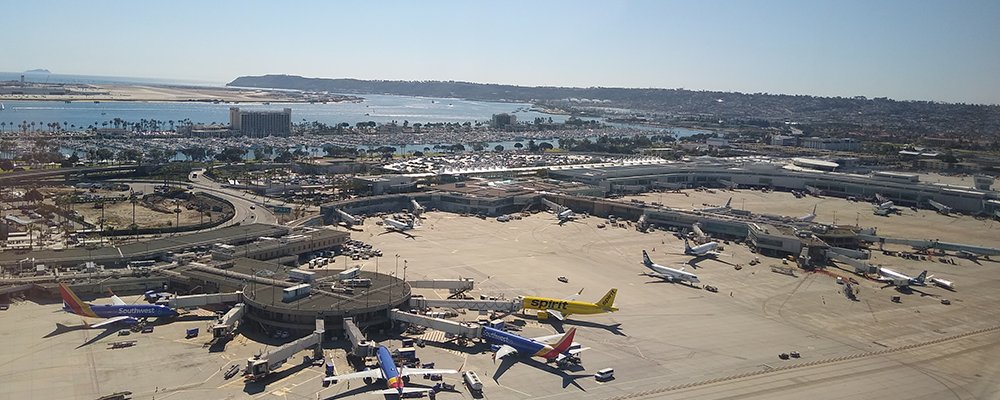
The architecture, entrusted to Gensler, choreographs the landside-airside sequence into a seamless, intuitive procession from curb to boarding gate. Its most iconic feature, a 244 metres long curved glass façade developed in collaboration with the artist and architect James Carpenter, disseminates natural daylight while tempering heat and glare.
This produces a bright, expansive space that recalls the city’s bayfront promenades and gardens. Thanks to an innovative system that allowed for the removal of structural columns, the ticketing hall feels more open, with a carbon footprint that has shrunk by 30%. Lastly, outdoor terraces overlooking the bay, flexible lounges and local concessions enhance the comfort and the profoundly appealing character of the site.
Frankfurt Airport Terminal 3
Frankfurt, Germany
Terminal 3 represents the fulfilment of one of the continent’s largest infrastructure projects. The terminal sits on 1.3 square kilometres of land, roughly equivalent to the size of Frankfurt’s city centre. While aiming for maximum efficiency, the terminal designed by architect Christoph Mäckler was contrived to be a lively urban environment.
To give travellers a smooth, familiar experience, its piers, boarding gates and lounges emulate the streets and squares of a city. Its aesthetics rely on noble materials in warm tones, like Jura limestone and travertine. Vast spaces, bathed in natural light thanks to large plate glass windows, create a soothing atmosphere while minimising the use of artificial light sources.
The architecture, which flawlessly blends sociability with technicality, delivers a constantly refreshed travel experience, as exemplified by three hanging ring-shaped sculptures, made up of coloured aluminium discs that rotate continuously, perpetually altering perceptions of the installation. Many of the features were planned from the outset to evolve with the terminal’s changing needs, taking a modular, visionary and sustainable approach that contributes to the project’s intelligence.
Three airports and/or airport terminals from the 2026 List will also receive a World Title (Prix Versailles, Interior or Exterior), to be awarded at the end of the year.
The above information sourced from Prix Versailles
 Andy Probert is a British-born, Cyprus-based journalist who covers aviation, hotels, travel, and various topics for publications worldwide.