
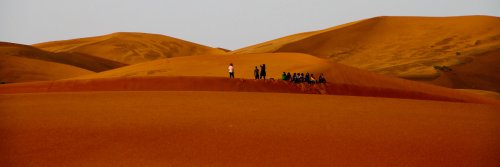
Trekking through a desert is like a very long walk in an oven, except the oven has no snacks and keeps pushing the horizon farther away. At first, you feel adventurous. You stride across the sand, wearing a hat that makes you look like a brave explorer—or a mushroom with excellent sun protection. You wanted the whole experience, not just a jaunty ride sitting behind a camel’s hump. It feels like the sun is shining directly into your soul. Your whole body grows heavier with every step (if you were silly enough not to engage an indigenous guide complete with carts—a Bedouin in Wadi Rum or Berber nomads in Morocco and Egypt. The sand sneaks into your boots, socks, pockets, and possibly your thoughts. You stop to shake it out, only to discover the desert has already begun to refill everything, and that camel with his tinkling bell meandering behind you suddenly looks like an attractive alternative to foot power.
Walking on dunes is surprisingly difficult. You climb one, reach the top, and see another dune waiting ahead like a sandy staircase designed by someone who dislikes knees. Your legs complain. Your lungs negotiate for a shorter route. Your local guide cheerfully announces, ‘Just over that ridge,’ which is desert code for ‘I have no idea, but let’s stay positive.’ The silence is enormous—no cars, no cafés, and no neighbors mowing their lawn. You may hear the wind whispering—or it may be your stomach asking whether the emergency trail mix (aka dates and maybe nuts if you are lucky) is still available. Every small discovery becomes an exciting find: a darting lizard, a distant carrion soaring then circling in a shimmering haze, or a shadow that turns out to be your own on the ground.

At night, the desert changes its personality. The blazing sun clocks out, and the temperature drops as if someone has opened a freezer door. You are dusty, tired, and slightly crunchy. You wrap yourself in blankets and gaze at a sky crowded with too many stars to count. For a moment, you feel tiny, peaceful, and deeply connected to the universe—until you remember you need to find the toilet in the dark.
You crossed a landscape that tested your patience, your legs, and your ability to drink water without spilling it down your shirt. The desert is beautiful, challenging, and unforgettable, with sand ranging from yellow to orange to red depending on the hour. And at the end of the day, it makes a shower feel like a royal ceremony, if there is one.
Visiting remote deserts around the world requires specialized transport, local guides, and careful planning to handle extreme terrain and isolation. Remote deserts are wonderfully peaceful—partly because they’re so difficult to get to. Fortunately, several ways let you reach these vast, sandy (and occasionally very rocky) corners of the planet without relying on a determined camel and a suspiciously old map.
Four-wheel drives and off-road adventures
A high-clearance 4WD can tackle unpaved tracks, gravel plains, and towering dunes, as long as you’re comfortable with dust in places you didn’t know dust could reach. Famous routes include Australia’s Canning Stock Route, where “quick detour” is not a phrase to take lightly, and guided crossings of the Sahara, Namib, and Arabian deserts. Bring water and spare supplies, and hire a driver who knows the difference between a dune and a very big mistake.
Specialized guided tours
For travelers who prefer an expert nearby, specialist operators organize deep-field trips into remote regions. Destinations may include Central Asia’s Tibetan Chang Thang and Gobi Desert, as well as the Sahara and Namib. Guides handle the complicated details—routes, logistics, permits, and what to do if the landscape appears to consist entirely of ‘more landscape.’ You can focus on the views and pretend you’re not checking your phone for a signal.

Bush flights and private charters
When roads become more of a hopeful suggestion, small charter planes and helicopters can provide a dramatic shortcut. They’re useful for reaching isolated wilderness lodges or far-flung areas such as Namibia’s Serra Cafema in the Hartmann Valley. The flight may be short, but the scenery is incredible—and landing somewhere animals may have to be cleared off the runway is a memorable experience.
Remote Deserts to put on your Radar
These vast landscapes serve up towering dunes, ancient trails, fossils, and enough space to make you reconsider whether you really needed to pack three pairs of ‘just in case’ shoes.
The Namib Desert, Namibia
The Namib is famous for its towering red dunes, the surreal salt-and-clay pan of Sossusvlei, and the shipwreck-strewn Skeleton Coast. It’s spectacular—and not interested in making your journey convenient. You can drive yourself on unpaved gravel roads, but you'll need a robust 4WD. Alternatively, fly in on a safari or join a guided expedition from dunes to ocean.
The Sahara, North Africa
Stretching across countries including Morocco, Egypt, Algeria, and Chad, the Sahara is less a single desert than an enormous collection of reasons to bring water. Expect rocky black landscapes, golden erg dunes, ancient caravan routes, and nomadic camps beneath a star-filled sky. Multi-day jeep tours, camel caravans, sandboarding, and dune-buggy trips are available from hubs such as Marrakech, Ouarzazate, and Cairo. Camels make charming transport, though they don’t seem to care about your comfort.

The Gobi, Mongolia and China
The Gobi combines dinosaur fossils at the Flaming Cliffs, icy gorges, and wide-open landscapes where nomadic families may welcome visitors to stay in a traditional yurt. Getting around usually means joining a 4WD tour or climbing aboard an overland van—often a sturdy Russian-built model with a personality of its own. Local nomadic families and specialist adventure agencies can help organize the journey. Pack for changing conditions: the Gobi can serve up dramatic weather with the enthusiasm of a restaurant offering a surprise tasting menu.
The Empty Quarter, Oman and Saudi Arabia
Also known as the Rub’ al Khali, the Empty Quarter contains some of the largest continuous sand expanses on Earth. It offers profound silence and remarkably dark skies, with little light pollution to compete with the stars. Guided 4WD convoys often depart from Muscat or Salalah and carry specialized desert-survival gear. The dunes are immense, and your phone will be less useful than a well-prepared local guide.

The Australian Outback and Simpson Desert
The Simpson Desert is famous for thousands of parallel red dunes and ancient salt lakes. Exploring it requires a well-equipped personal 4WD, satellite communication, and sensible preparation—or a seat in an escorted convoy or tag-along group. The scenery is extraordinary, the distances are vast, and the nearest helpful stranger may be several dunes away. In short: bring supplies, follow local advice, and don’t mistake confidence for fuel.
Whatever massive sand pit you choose to explore, follow local advice, respect the environment, and get the right travel insurance. The desert may look empty, but it has its own rules—and it won’t accept Wi-Fi complaints.
Gail Palethorpe, a self proclaimed Australian gypsy, is a freelance writer, photographer and eternal traveller. Check out her website Gail Palethorpe Photography and her Shutterstock profile.